How is a voice impression scored? Meet our judges
In Battle mode, four judges raise a score out of 10 after every take. Behind them there's no human, just an algorithm that compares your take with the original sound. Since nobody actually sounds like a car alarm, the real question is what it compares. Here's how it works, without the jargon.
In short
A voice impression is scored on its shape, not on your voice. In TryToAct's Battle mode, the algorithm trims the silences, compares how the sound moves (lows, highs, vowels) while ignoring the pitch and tone of your voice, forgives small timing slips, then checks loudness and length. The result becomes four judges' scores out of 10. Power-up cards add a few points at most and never take any away.
The problem: you will never have the same voice as the original
When you imitate a goat, a car horn or a cartoon character, your take will never match the original sample for sample, not even in pitch. Yet a deep voice and a high voice can pull off an equally good impression.
A human judge doesn't ask whether it's the same voice, either. They ask three things:
• Does it start, swell and stop like the original?
• Does the "color" of the sound move the same way? An "aaa-OOO" that changes vowel, a hiss that turns into a bang…
• Is it about as long?
Our judges listen for those same three things.
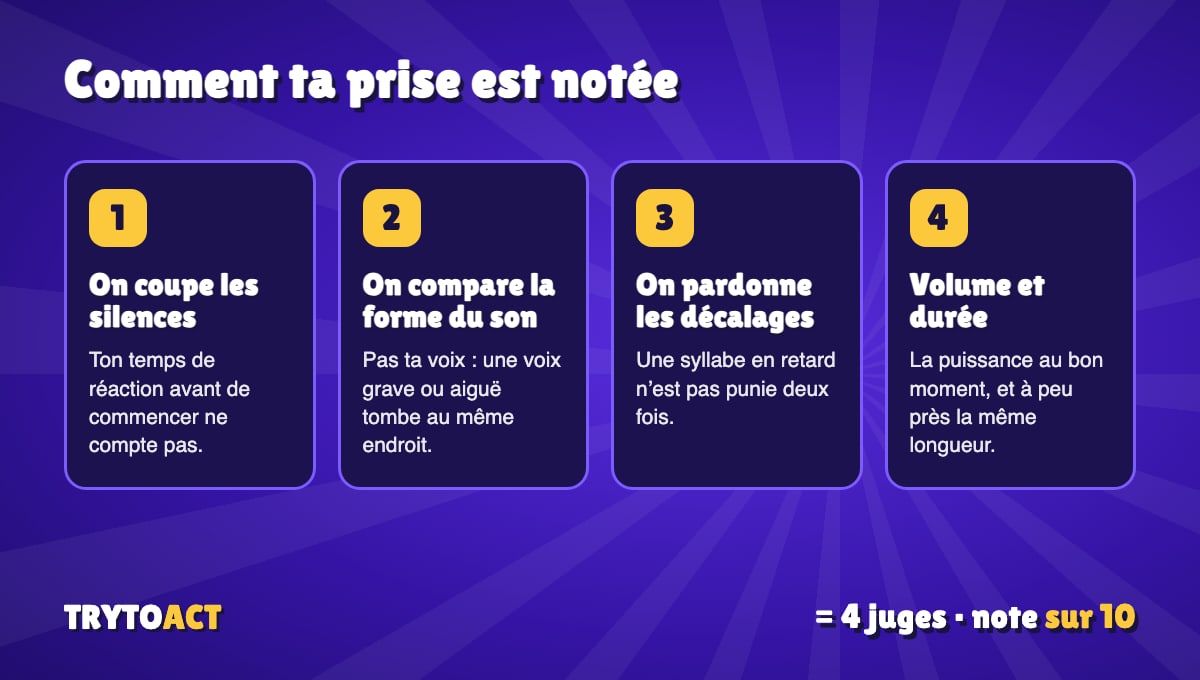
Step 1: we trim the silences
Your take and the original sound are first cut down to the part that actually makes noise. If you waited half a second before starting, it doesn't count against you. If your take is empty (muted mic) or holds nothing but steady background noise, it is recognized as such and scores nothing.
Step 2: we compare the shape of the sound, not your voice
Each tiny slice of sound (a hundredth of a second) is reduced to its spectral shape: roughly, the outline of its lows and highs, smoothed so that a deeper or higher voice lands in the same place. Specialists call it the mel-frequency cepstrum, the same family of tools speech recognition uses. We also strip out most of what comes from your mic and your room: a phone mic and a streamer's mic give comparable results.
Step 3: we forgive timing slips
If your second syllable comes in a little late, a time-alignment algorithm (DTW, or dynamic time warping) stretches and squeezes time to line your take up with the original. You are not punished twice for one late start. The alignment has its limits, though: it can't bend your whole take out of shape to pretend it fits.
Step 4: loudness and length
Next, we look at the loudness curve (did you put the power in at the right moment?) and at how long your take lasts compared with the original. The match on the shape of the sound is multiplied by these two. So a perfect impression that runs twice as long can't get a 10.
Why four judges and a score out of 10?
The result is converted into scores out of 10, and the average of the four judges is exactly your score for the round. The number on screen can never contradict the paddles the room just saw go up. Over the whole game, these scores add up to the final ranking.
What about the power-up cards?
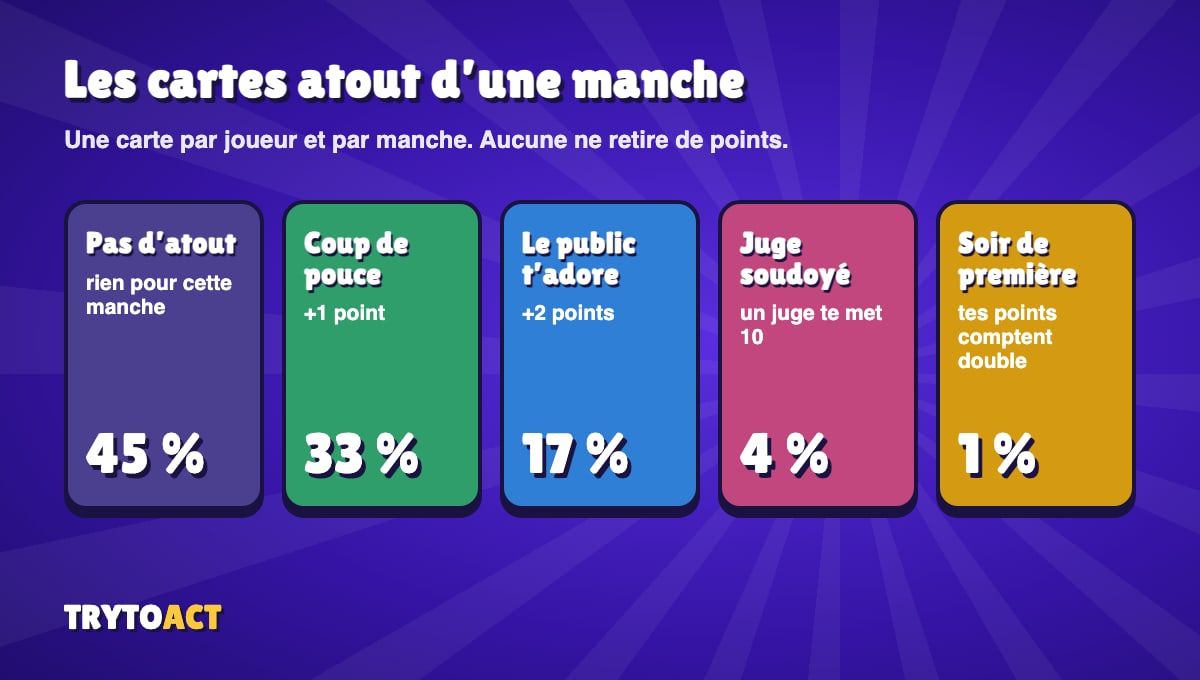
Every round, each player gets a card, drawn independently of everyone else. Here are the real odds:
- No power-up
The most common card: the round counts exactly as the judges scored it.
- Effect
- None
- Odds
- 45%
- Little boost
- Effect
- +1 point
- Odds
- 33%
- The crowd loves you
- Effect
- +2 points
- Odds
- 17%
- Bribed judge
- Effect
- One judge gives you a 10
- Odds
- 4%
- Opening night
The rarest one.
- Effect
- Your points count double
- Odds
- 1%
No card takes points away. Over a five-round game, luck moves a total of only about two points out of fifty. A player who imitates one point better per round almost always wins. Being lucky is never worth more than imitating well.
Do we keep your voice?
The score is calculated by a signal-processing algorithm, not by an AI trained on voices. For everything we do (and don't do) with your recordings, we wrote a dedicated article, in French: does your voice train an AI?
Three tips to score more points
• Wear headphones. Otherwise the original sound leaks back into your mic and muddles the comparison.
• Match the length. A decent impression that's well timed beats a perfect one that runs over.
• Copy the shape before the voice. Start loud if the original starts loud, make the sound rise or fall at the same moment. The exact tone of voice matters a lot less than you think. To warm up first, our voice improv exercises work for impressions too.
Frequently asked questions
Does a deep or high voice put me at a disadvantage?
No. The score compares the shape of the sound (how it moves, its loudness, its length), not the pitch or tone of your voice.
Does an AI listen to and keep my recordings?
The score is calculated by a signal-processing algorithm that compares your take with the original sound. It is not an AI trained on your voice.
Why did I get 0 when I shouted?
If the mic picked up nothing, or only steady background noise, the take counts as empty. Check that your browser has access to the right mic.
Can power-up cards make me lose?
No. No card takes points away. Over five rounds, luck shifts a total of about two points out of fifty.