How to do cartoon voices: techniques and exercises
Cartoon voices have one thing in common: they are exaggerated. That's what makes them fun to imitate, and it's also what hurts your throat when you go about it the wrong way. Voice actors rely on a few simple levers (pitch, placement, rhythm and a smile) to build a voice without straining. Here's how to use them.
In short
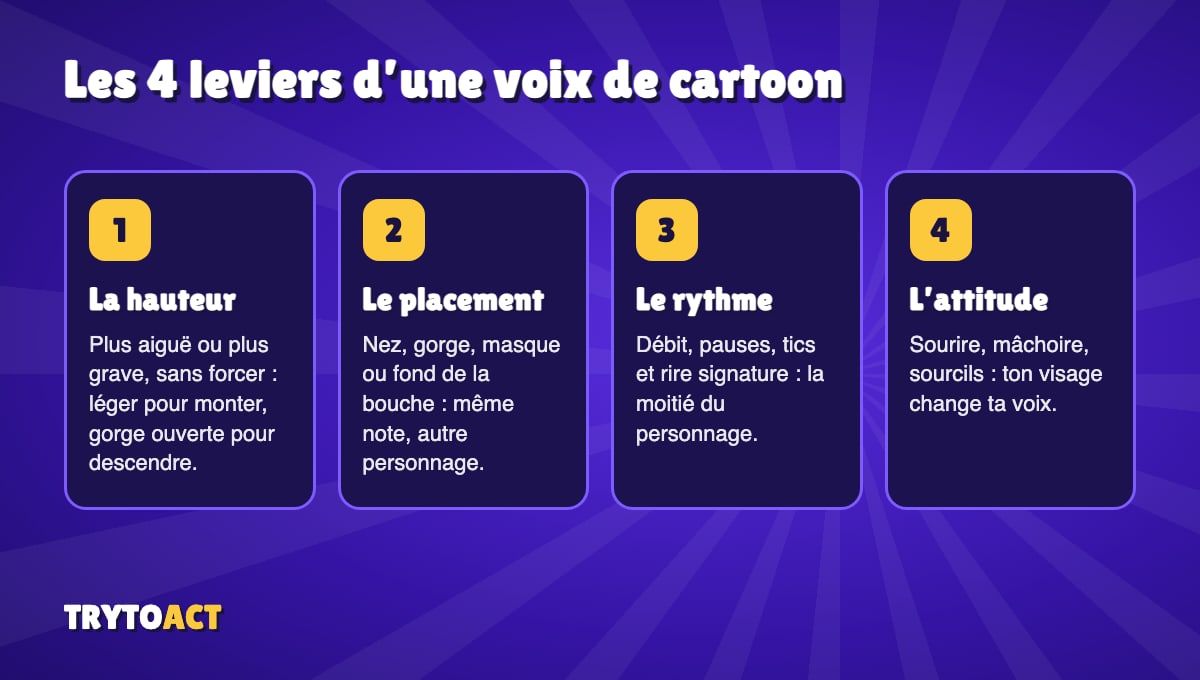
To do a cartoon voice, you work four levers: pitch (higher or lower than your natural voice), placement (in the nose, the throat or the front of the face), rhythm (pace, pauses, verbal tics) and attitude (smile, jaw, posture). The key is to exaggerate the shape rather than push the volume, to warm up first and to stop as soon as your throat feels scratchy. You can practice on scenes in TryToAct's dubbing game and on short sounds in Battle mode.
Lever 1: pitch
Most cartoon voices sit higher or lower than a normal speaking voice. To go up without hurting your voice, think "light": less air, more smile, as if you were talking to a baby. To go down, open your throat as if you were yawning instead of crushing your voice. If you feel it rubbing, come back up a notch.
Lever 2: placement
This is the voice actor's secret. The same pitch sounds completely different depending on where you "place" the sound:
• In the nose: the nasal voice of the grump or the wise guy. Pinch your nose lightly to check: if the sound changes a lot, you've got it.
• In the throat: the gravelly voice of the villain or the big bruiser. Go easy, it's the most tiring one.
• In the mask (cheekbones, front of the face): the bright, projected voice of the eager hero.
• At the back of the mouth, as if you had a hot potato in it: the heavy, grumbly voice.
Lever 3: rhythm
You recognize a character as much by how they talk as by their voice: the rapid-fire chatter of a jittery little animal, the villain's dramatic pauses, the signature laugh, the sigh. Before working on the voice, copy the rhythm in a whisper: you'll find half the character is already there. Rhythm and intonation are also what TryToAct's accuracy score measures (how the scoring works).
Lever 4: attitude
Your face changes your voice. A big smile brightens the sound, a jutting jaw makes it menacing, raised eyebrows make it naive. Plenty of voice actors perform standing up and act out the character, even in front of a mic. Do the same: it's more fun and it sounds more convincing.
The main voice types and how to do them
- The nasal grump
Think Squidward muttering under his breath.
- Pitch
- Medium
- Placement
- Nose
- Tip
- Tight jaw, choppy delivery
- The tiny high voice
Chipmunks, mice, babies.
- Pitch
- Very high
- Placement
- Mask
- Tip
- Smile, little air, fast pace
- The villain
The sneer does half the work.
- Pitch
- Low
- Placement
- Throat, in moderation
- Tip
- Long pauses, punchy consonants
- The giant or the brute
Slow, heavy, a little simple.
- Pitch
- Low
- Placement
- Back of the mouth
- Tip
- Throat open like a yawn
- The eager hero
Everything is an adventure, SpongeBob style.
- Pitch
- Slightly higher
- Placement
- Mask
- Tip
- Project, smile, end your sentences on the way up
The Simpsons as an example
Homer and Marge have been voiced by the same two actors since the very beginning: Dan Castellaneta and Julie Kavner. Castellaneta has said that Homer started out as a loose impression of Walter Matthau before turning into the voice everyone knows. Homer is a good exercise: a fairly low, slightly drawling voice, with very short bursts of frustration, like his famous "D'oh!". Short sounds like that are exactly what you imitate in Battle mode.
3 exercises to practice
• The siren: slide from your lowest note to your highest on an "oo", then come back down. It warms you up and shows you your comfortable range.
• One line, five voices: say "What are you doing here?" as the grump, the tiny high voice, the villain, the giant and the hero. Record yourself.
• Rhythm first: pick a cartoon line, whisper it copying only its rhythm, then add the voice.
For fuller workouts, see our guides on warming up your voice and our voice improv exercises.
Protect your voice
• Warm up first: yawns, sirens, lip trills.
• Drink water at room temperature.
• Don't shout: a powerful character comes from placement, not volume.
• Stop as soon as it scratches or your voice turns hoarse.
And if your voice won't go high enough, cheat a little: TryToAct's voice filters (Chipmunk, Deep, Monster…) do the rest.
Frequently asked questions
How do I do a high cartoon voice without hurting myself?
Smile, use little air and place the voice in the mask (the front of your face) instead of squeezing your throat. Stop as soon as it scratches.
How do I do a cartoon villain voice?
A low voice, placed a little in the throat without forcing, long pauses and punchy consonants. The sneer is half the character.
Who voices Homer Simpson?
In the original version, Homer Simpson is voiced by Dan Castellaneta and Marge by Julie Kavner, both since the very beginning of the show.
Where can I practice doing voices?
On TryToAct, for free: by dubbing scenes with an accuracy score, or by imitating short sounds in Battle mode.